Upcoming Posts

News to Know - Mondays
Dictum Diei - Tuesdays & Fridays
Verseday - Thursdays

Thursday, 20 January 2011

When God does not Deliver


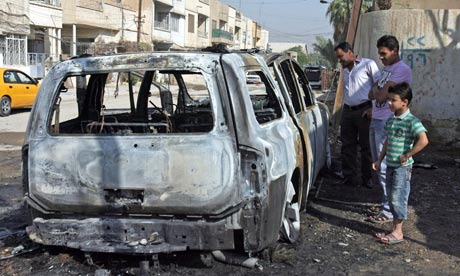
I recently heard an idea which haunted me for days. It was one of those terrible truths of which I was already aware, but had never expressed, and had thus only seen peripherally. “God does not deliver his people for their temporal happiness.” Those were the offending words that appeared in the middle of a sermon. It was not meant to be a spectacular point, merely an observation, but it is shattering when one is accustomed to musing only on God’s provision and material blessing. It is an offensive thought, but one whose truth is impossible to deny. More Christians are being imprisoned and killed now than ever before.

Our culture is increasingly hostile to Christianity, and I like to be reassured that any future persecutions will be light; I can handle glares and minor inconveniences. I do not mind being purposefully offended for Jesus’ sake. Heck, if offending me was a crime, I could already file ten lawsuits every day. What makes me uncomfortable is any threat of imprisonment, torture, or death. If God is going to deliver me from anything, those are the situations I would like to be delivered from. My happiness and comfort depend much on being free, not-tortured, and alive. It scares me to think that God might not deliver me from oppression, but he often seems to not deliver his people. God even gave his Son over to be killed.

After a few days, I realized what the problem was. I am the problem. All of my concern revolves around my own comfort and what I think is right and best. God too, is concerned about my wellbeing, but I often define “wellbeing” differently than God does. I am not forgetting that the church is commanded to care for persons’ temporal needs, and I am not diminishing the reality and gravity of those needs. Rather, I mean to highlight the two realities: the spiritual and the physical. Both are equally real, but the spiritual reality is greater than the physical reality because bodies die; souls do not. Even if I never know starvation, I will one day be unable to eat. Even if God delivers me from imprisonment or a fatal beating, I am eventually going to die. The question is not if I will suffer and die, but rather, when will I die and to what degree will I suffer?

Furthermore, in requiring God to deliver me from an untimely death, I am guilty of a monstrous arrogance. God’s purposes are greater than my own. As the answer to the first catechism question states, man’s chief end is to glorify God and to enjoy Him forever. I exist to bring glory to God and I can never place my safety or comfort above that purpose. If God is most glorified in not delivering me from those who have declared themselves my enemies, so be it. I must seek the Kingdom of God more than I seek life.

God’s grace is sufficient (2 Cor 4, 5:1-10, 2 Cor 12:9-10).

[Image source]

Wednesday, 12 January 2011

A Quote from Bonhoeffer

"In Jesus Christ the reality of God has entered into the reality of this world. The place where the questions about the reality of God and about the reality of the world are answered at the same time is characterized solely by the name: Jesus Christ. God and the world are enclosed in this name. . . we cannot speak rightly of either God or the world without speaking of Jesus Christ. All concepts of reality that ignore Jesus Christ are abstractions."

-Ethics, Dietrich Bonhoeffer

Thursday, 16 December 2010

Fresh Air and Fresh Books

I finished my undergraduate studies this past Saturday, December 11. Now that I have room to breathe, I'm reading a number of good books, including Bonhoeffer by Eric Metaxas. A close friend gave me the book as a Christmas present, and it has been amazing--(an adjective which applies to my friend, as well). Reading about Bonhoeffer's life is an inspiration and encouragement to me, even if I do find his intellect intimidating. At any rate, if you're looking for a book to read over Christmas break, this one would be a good choice.

I'm hoping to get myself back on a less sporadic blogging schedule soon.

Tuesday, 30 November 2010

Undergrad? Done.

Dear friends,

I ought to explain why I suddenly dropped off the blogosphere radar after my last post. My excuse is a single word: college. I am happy, however, to share that it is also my last undergraduate semester and ends in a mere 11 days. If idleness is the devil's workshop, let me assure you that this semester has been a veritable factory of righteousness. I limited myself to 16 credit hours this semester because I wanted to enjoy a bit of free time; I was tired of working so hard. Well, those 16 hours have turned out to be a very large 16 hours, and left me with no free time at all. At any rate, I'll be back very soon.

Friday, 17 September 2010

Power-Grabbing, Are We?

As we know, whoever controls the definitions controls the debate. For instance, all that is necessary to institutionalize perfectly sane persons is to redefine madness. A government unhappy with dissent need only redefine madness in terms of political disapproval, and--abracadabra--half of society is mad. Thus, any time a government introduces new definitions or euphemisms, we ought to be wary.

It turns out the White House wants you to start calling it "global climate disruption" rather than "global warming." Why? Because "global climate disruption" is vaguer, and because it is vaguer, it means that laws giving the government the ability to shove 'greenness' down your throat will suddenly be able to apply more broadly.

Having bonfires in your backyard leads to global warming. No more s'mores, kids. But what about cutting down that tree that leans precariously over your child's bedroom? Sorry, climate disruption. It'll have to stay. Move your kid. Thinking about buying a dog? Sorry, climate disruption. Your backyard will never be the same. Want to fertilize your asthmatic lawn? Isn't that climate disruption, too?

My point is this. Your environment is whatever surrounds you. Environmentalism might as well be called 'Everythingism.' And the moment our surroundings become more important than the persons who inhabit them, we haven't become 'environmentally conscious;' we've become anti-human. Even most murderers aren't anti-human. They just hold a grudge against a single person, or a single group of a people. But to be anti-human is a much bigger thing. Any racist is more humane than a person who despises the existence of more than six billion humans.

And don't give me the "Environmentalism means to save the planet to save humanity--you have it backwards" line. If it was about humanity, the emphasis would be on greater production and freedom, not limiting production and limiting freedom. The question ought to be "how can we meet the needs of the peoples of the world?" rather than "how can we keep folks from killing the planet?" If you meet the world's needs, the planet will take care of itself*. If you try to save the planet, you'll destroy humanity.

*(Do you think the folks cutting down rain forests do it because its fun? Or because they need money? Notice that only wealthy countries can afford to preserve their land. And my pet peeve: as long as the UN keeps cheap power out of Africa, nobody in Africa will care about anything but their immediate needs. Environmental policies that prevent development kill poor people.)

Rant over. Peace.